
Retrofit: your existing installation brought up to date
Intralogix modernises existing stacker cranes, shuttles and conveyor systems. The proven mechanics stay where they are; we replace everything that determines performance, reliability and maintainability. We do this independently of the original manufacturer, in the Benelux, Germany, France, the United Kingdom and Asia. Our people know the installations from Lalesse, Dematic, MIAS, Swisslog, Dambach, LTW and TGW first-hand.
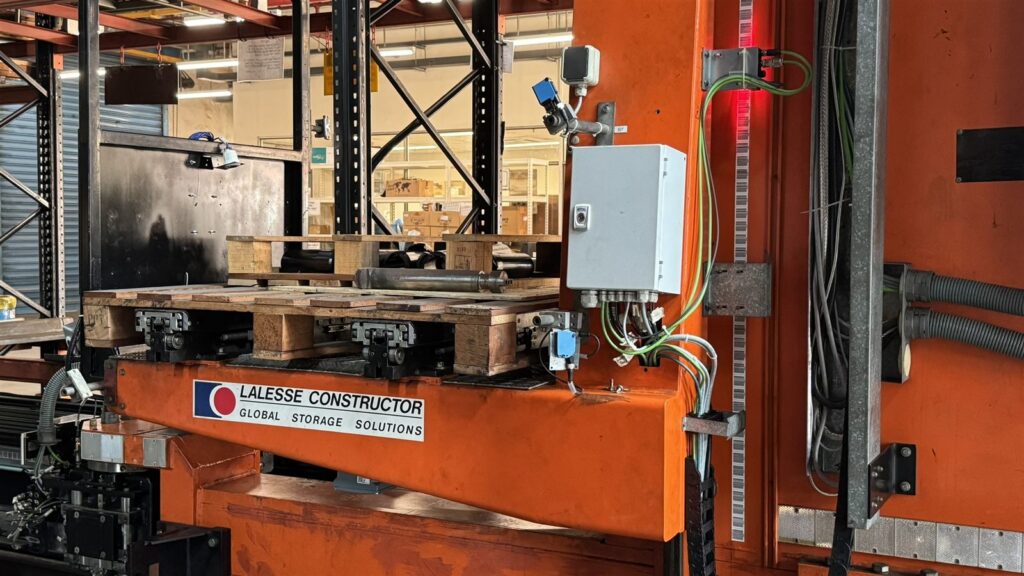
When a retrofit is the right choice
The steel structure of a stacker crane lasts for decades. The electronics do not. What you usually notice first:
- components are hard to source or no longer available, so one faulty part can mean days of downtime;
- the control system is no longer supported by anyone;
- diagnostics tell you nothing useful when the installation stops;
- throughput is falling while your process is growing;
- remote support is not possible, so every fault means an engineer on site.
Sounds familiar? Then something has to happen. The only question is which is cheaper: replacing or modernising.
What a retrofit gives you compared with a new installation
A retrofit is finished sooner, calls for considerably less downtime and costs a fraction of a replacement installation. You also keep a substantial amount of steel out of the scrapyard. The structure that has stood there for twenty years will still be standing in twenty more.
Most important of all: the ageing problem is gone for good. Components are available again for years to come, diagnostics are useful again, and remote support becomes possible.
The result in motion
A fully modernised stacker crane, back in service and at full speed in the real process. Original mechanics, completely new technology.
The difference is in the movement: smooth acceleration, stable running at speed, controlled positioning without sway, and accurate fork movements at the racking.
What we replace
In a full retrofit we replace:
- the control system: PLC, software and positioning;
- the drives and the drive control;
- the safety technology, including the speed limiter;
- sensors and photocells;
- the peripheral I/O;
- hoisting ropes and energy chains;
- the electrical installation.
The load-bearing steel structure stays in service. There is nothing wrong with it, which is why a retrofit pays off.
We do not limit ourselves to the electrical side. Parts that wear or are safety-critical, such as the hoisting ropes, the speed limiter and the energy chains, are included. A new control system on worn components is not modernisation but postponement.
Just as important is what you do not see: full diagnostics on the operator panel, clear alarm handling and remote support.
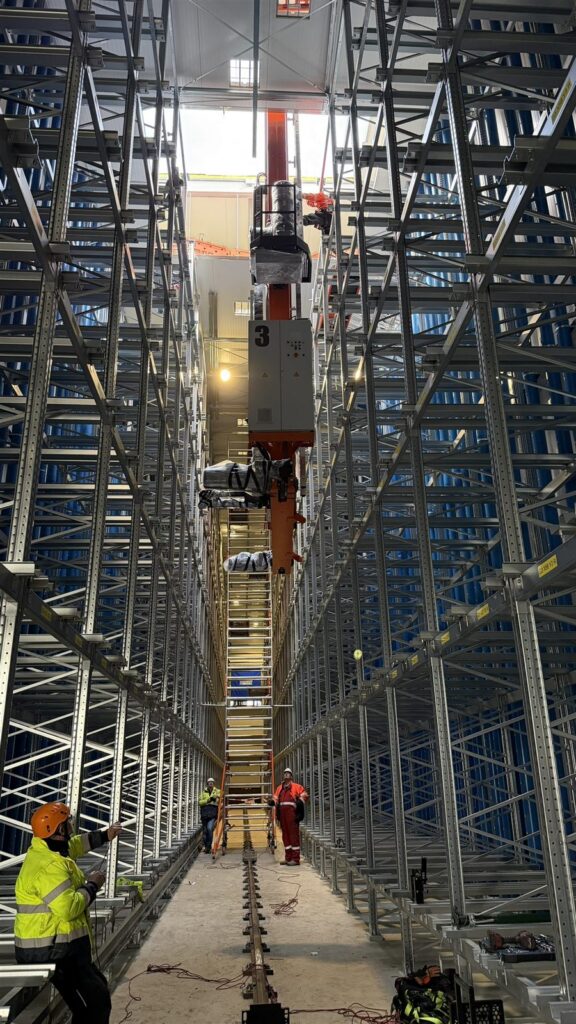
You do not have to do it all at once
You are often offered only “all cranes in one go”. With us it can also be done step by step, and there are two good reasons for that.
Budget. Not every customer has room for the whole installation in one financial year. Phasing spreads the investment: one crane this year, the next one next year.
Certainty. A modernised crane has to prove itself first. Does it run as promised, under your real load? After a period in production you know. Only then do we take the next step together: the next crane.
And if there is really no other way, we will even phase within a single crane: replacing components step by step, with the installation running partly on the existing hardware in between. It is not our preference, because it makes the project more complex and the return comes later. But it can be done.
With several identical cranes, the second one benefits immediately from everything worked out on the first: shorter downtime, faster commissioning, the same software and the same spare parts for both machines. You end up with one modern standard instead of two ageing cranes each with their own problems.
On your site, or in our own workshop
A retrofit can be done in two ways, and which suits you best depends on your situation.
On your site. The installation does not have to go anywhere. We are set up for what that involves: limited access, a warehouse that carries on running alongside the project, local supply lines, and a fixed window in which the crane has to be taken out of service, converted, tested and released again.
We carry out this work well outside the Netherlands too. In Singapore we modernised two stacker cranes on site. The engineering was done in Europe; our own team installed and commissioned them there, while the warehouse kept running.
In our own workshop. If your installation can be spared, we collect the crane and rebuild it at our premises. That is faster and more controlled: no restricted access, no production around it, and the crane has already been tested on delivery.
Which is the wiser choice in your case is something we decide together beforehand. It depends on your downtime window, how accessible the installation is and how many cranes can be out at once.
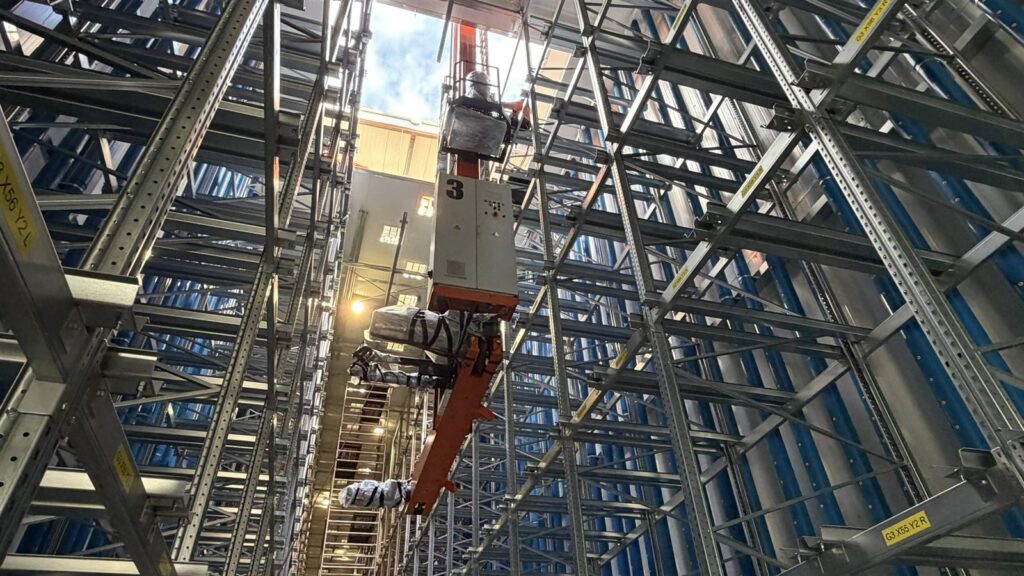
Taking over an existing installation and modernising it
There is a route into warehouse automation that is often overlooked: taking over an existing installation that becomes available elsewhere, and having it modernised.
The gain is mainly in time. Order a new installation today and you will wait a long while. Take over an existing one and have it converted, and you have capacity in place within a fraction of that time. The financial advantage comes on top of that, but is usually not the deciding reason.
We handle the whole project. Dismantling at the old site, transport, full modernisation in our own workshop, and installation and commissioning at the new site. You do not have to find a second party for any of it, and there is one point of contact from start to finish.
Reference: three cranes from Woerden, now in a cheese warehouse in the north
In Woerden, a cheese warehouse closed its doors. Another company took over the installation: three stacker cranes that had run perfectly well there, but which had to be moved and modernised.
The deciding factor was not price but delivery speed. The financial picture came afterwards.
We fully modernised the cranes in our own workshop: control system, drives, safety technology and the wear parts. What now stands in the north of the Netherlands amounts in practice to three as-new cranes.
The warehouse is temperature-controlled. That brings requirements you do not meet in an ordinary warehouse: choice of materials, lubrication and protection of electronics against condensation. We allow for that in the way we carry out the work.
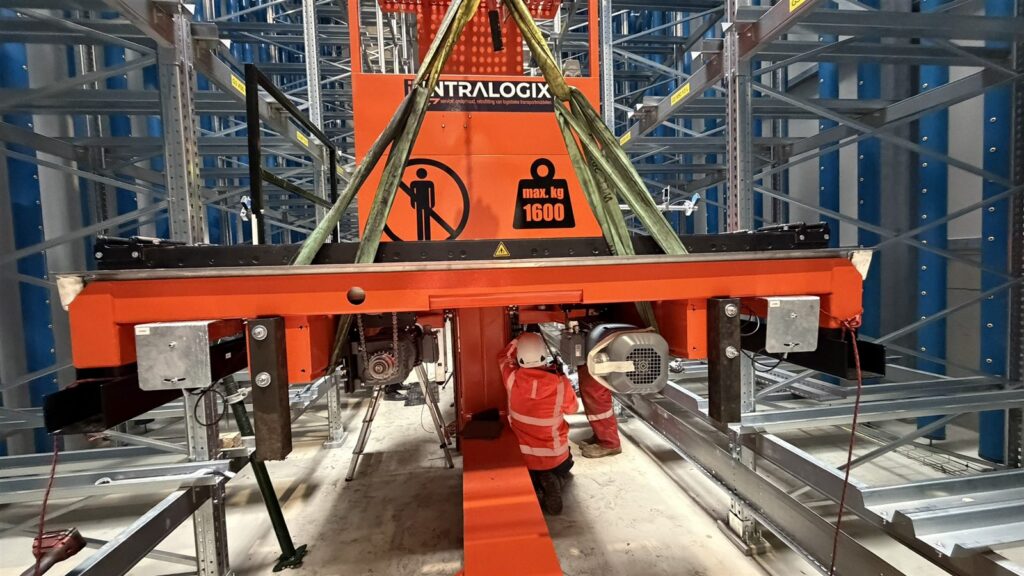
What determines the lead time
Quoting a fixed lead time would mislead you. What determines it: the budget available and over what period it becomes available, the maximum downtime your process can take and in which window, the number of cranes and whether they are identical, exactly what is being replaced, the quality of the documentation on the existing system, and component lead times.
We draw up the plan with you beforehand.
Want to know what we do on your make? See the brands page. Photographs of completed projects are in the gallery.
Frequently asked questions about retrofit
When is a retrofit cheaper than a new installation?
As soon as the steel structure is still sound and only the technology around it has aged, as is the case with almost every installation of fifteen years or older.
The steel structure is the most expensive and the longest-lasting part of a stacker crane. Replace it and you pay again for something that has decades left in it. Leave it standing and you pay only for the parts that are genuinely worn or obsolete.
How much downtime does a retrofit cost?
That depends on what is being replaced and on whether the work is done at your site or at our workshop.
If the installation can be spared, we collect the crane and convert it at our own premises. Everything then happens without restricted access and without production going on around it, and the crane arrives already tested.
If it has to be done on site, we work within a fixed window in which the crane goes out of service, is converted, tested and released again. We plan that around your production.
Can it be done in stages, one crane at a time?
Yes, and that is more often sensible than doing everything at once.
For two reasons. Budget: not every customer has room for the whole installation in one financial year. Certainty: a modernised crane has to prove itself first under your real load. If it runs as promised, we take the next step together.
With several identical cranes, the second benefits immediately from everything worked out on the first: shorter downtime, the same software and the same spare parts for both machines.
Do you work on makes you have not carried out projects for?
Yes. On some makes we have carried out projects ourselves; on others the experience lies with our engineers.
A stacker crane consists of a steel structure, drives, a hoist, safety technology and a control system, all parts we work on every day. The technology differs less between makes than between years of construction.
What we have carried out per manufacturer, and where that experience comes from, is on the brands page.
Will our warehouse control system still work after a retrofit?
Yes. We connect our control system to the system you already use.
Your processes and the way your people work stay untouched. Only the layer that no longer holds up technically is replaced. If you do not yet have such a layer, we can supply that too.
What should I watch out for if I want to take over a second-hand installation?
Three things, and it pays to have them assessed before you buy.
Does it fit? Build height, rack pitch and the layout of your warehouse decide whether the installation can stand at your site at all. Is the steel sound? That is the part you are taking over and precisely the part you do not want to replace. How complete is it? Are the control system, the load handling devices and the documentation included, or are you buying the structure alone?
We assess that and then handle the whole route: dismantling at the old site, transport, modernisation at our own workshop, and erection and commissioning at yours. An installation that does not fit, or is not complete, ends up costing more than it brings in.
Retrofit because of an obsolete control system
A large share of the retrofits we have carried out came from a control system that could no longer be maintained: a Simatic S5, an S7-300/400 whose parts are running out, or an S7-mEC that is no longer supplied.
If that sounds familiar, read on about control system migration.
Considering a retrofit?
How many cranes, and for how long can you do without them? With that we can put together a proposal that fits your budget and your downtime window.