
Service and maintenance for your logistics system
Intralogix carries out preventive maintenance and breakdown response for stacker cranes, shuttle systems and roller conveyor systems. Independent of the original manufacturer. Our people know the installations from Lalesse, Dematic, MIAS, Swisslog, Dambach, LTW and TGW first-hand.
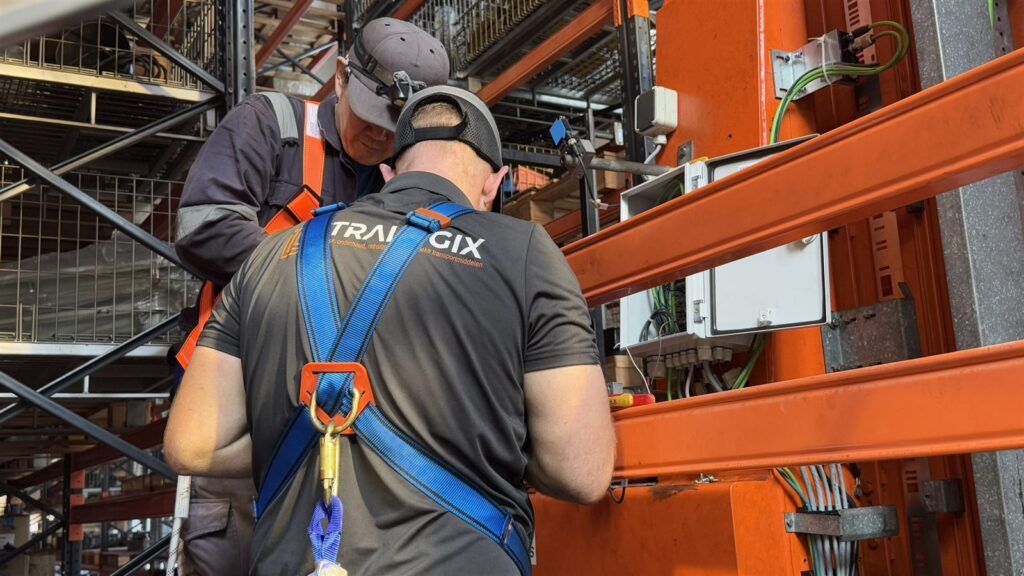
A stacker crane is not a machine you only touch once it has stopped. Parts wear out predictably: hoisting ropes, drives, sensors, energy chains. Replace them in time and you choose the moment yourself. Wait until something breaks and the moment is chosen for you, usually on the busiest day of the year.
Preventive work and breakdown response
We do both.
Scheduled maintenance at intervals that match how hard your installation runs. We come at agreed times, check what there is to check, replace what needs replacing and record what we found.
Breakdown response when something goes wrong unexpectedly. Our engineers know these installations; they are not working out how the machine functions, only where it is going wrong.
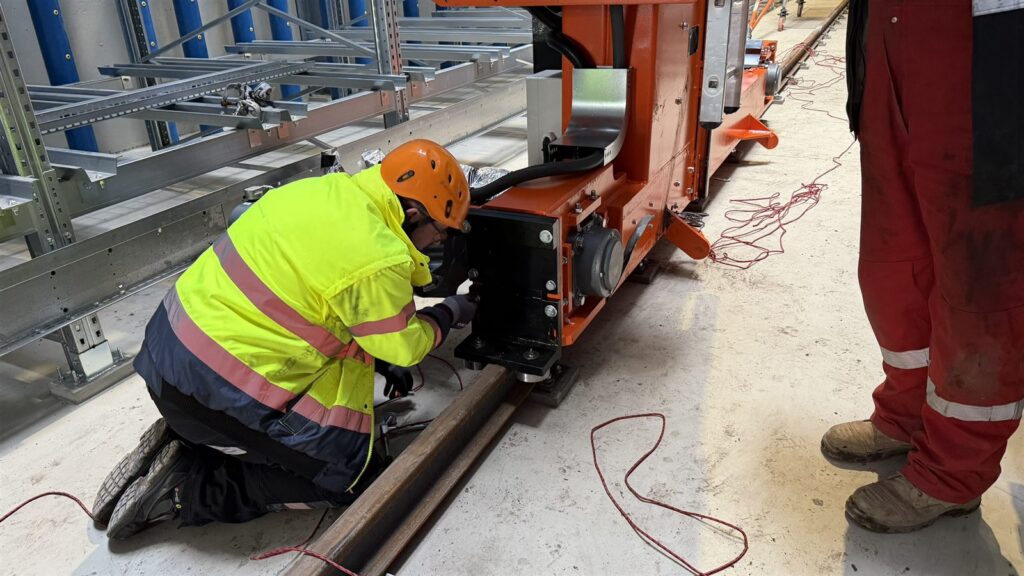
We work to our own checklist
Maintenance here is not a walk-around. Every crane is worked through using our own checklist, from which we cover the points that apply to your type of crane. Those checks run across the whole machine: general safety, travel gear, drives and gearboxes, mast and bottom beam, hoist, top beam and aisle-changing mechanism, current collectors and cabling, carriage and load handling device, the fall arrest and overload protection, the control cabinets and the operator controls. Once a year we include the rail track as well.
A few examples of what is on that list:
- broken strands, cracking and lubrication of the hoisting rope;
- the speed limiter, the safety rope and the safety brake;
- the brake air gap of the hoist and travel motors, measured and recorded;
- wear on the travel wheels, measured and recorded;
- the V-groove and axial play of the rope sheaves;
- the condition of the energy chain running to the carriage;
- the alignment of the current collectors;
- filters, fans and the PLC batteries in the control cabinet.
We measure; we do not just tick boxes. Where wear is involved we record the actual dimension. Across several visits that shows us the trend, so we can tell you that a part will need replacing at the next service, rather than finding out today that it is already worn. That way you plan a replacement rather than wait for one.
On every visit we also record what is there: the serial numbers of the hoisting rope and the speed limiter, the hour meter reading of the crane and anything that struck us. Over time you build up a file on your installation.
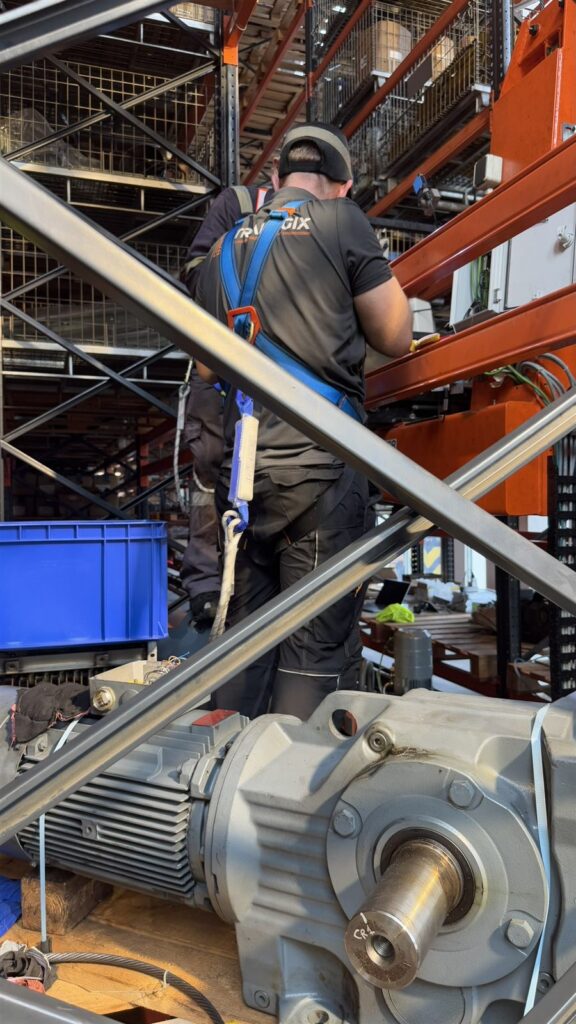
Two ways to buy maintenance
Under a maintenance contract. We come as agreed, at a contract price fixed in advance. The visits are in our schedule and you know what it costs.
And the most important part: contract customers take priority when a machine goes down. When it happens, that is what counts.
On call. You ring when something is wrong and we schedule it together, as far as is possible. You pay the applicable rates. More expensive per visit and without priority, but you are not tied to anything.
Which suits you depends on how critical your installation is. If your whole process stops when the crane stops, you already know the answer.
Looking in without driving out first
Where the installation is set up for it, our engineers can look in remotely. That saves time in making the diagnosis, and often a fault is cleared before anyone is on the road.
On installations we have modernised, that facility is there as standard.
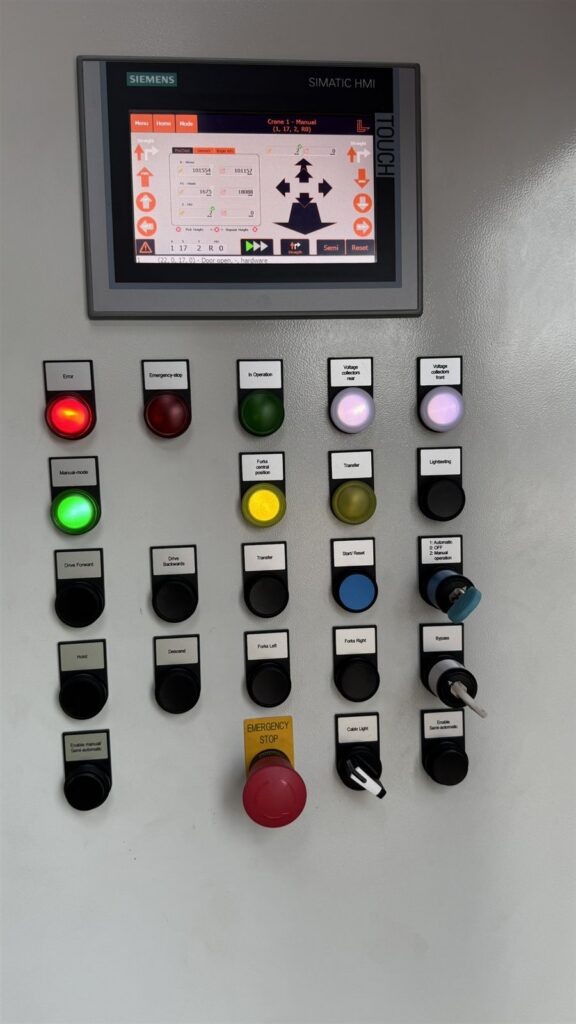
Where we work
For maintenance we work mainly in the Benelux and Germany. Where needed we travel worldwide: we have modernised installations as far away as Singapore.
Independent of the manufacturer
We are not tied to one manufacturer. Our engineers come from crane building and know these installations from the structure through to the control system.
If reliability is falling because parts are no longer available, carrying on repairing means pouring money into a bottomless pit. At that point it is time to talk about retrofit.
Wondering what we do on your make? See the brands page for what we have carried out per manufacturer, and where our engineers’ knowledge comes from.
Frequently asked questions about maintenance
How often does a stacker crane need maintenance?
That depends on how hard the installation runs. We set the schedule to that rather than to a fixed number of visits per year.
If your warehouse runs in shifts, hoisting ropes, travel wheels and energy chains wear faster than on an installation that stands still for part of the day. We include the rail track once a year.
What exactly do you check?
We go through every crane using our own checklist and work through whatever applies to your type of crane. The checkpoints run across the whole machine: general safety, travel gear, drives, mast and bottom beam, hoisting gear, top beam and transfer mechanism, current collectors, platform and load handling device, the fall and overload protection, the control cabinets and the operator controls.
Where there is wear, we note the measured figure: the brake gap, the running wheels, the rope sheaves. Across several visits you see the trend, which lets us tell you that a part will need replacing at the next service rather than this one.
What is the difference between a maintenance contract and maintenance on call?
With a contract, the visits and the price are fixed in advance, and you get priority when something breaks down. On call, you pay per visit at the applicable rates and you fit into the schedule as it stands at that moment.
The trade-off is rarely about the price per visit. Work out instead what a single day of downtime costs you. If that is more than the price difference over a whole year, the contract is the cheaper of the two, even though the quotation shows a higher figure.
Do you maintain installations you did not build?
Yes, that is by far the largest part of our work.
We work independently of the original manufacturer. Our engineers come from crane building and know the installations from Lalesse, Dematic, MIAS, Swisslog, Dambach, LTW and TGW, among others, first-hand, from the structure through to the control system.
Per manufacturer, the brands page sets out what we have carried out.
Can you look in remotely when something goes wrong?
Where the installation is prepared for it, yes. Our engineers look into the control system, read out the fault messages and see what the machine is actually doing at that moment, not just what is being described over the phone.
If your installation is not prepared for it, that can still be added. With a modernisation it is included as standard.
What happens when maintenance no longer pays off?
Then we say so, even when it costs us a maintenance contract.
The turning point is usually easy to recognise: faults come more often, the wait for parts gets longer, and more and more often the failed part is not available at all. From that moment on you are paying for an availability you no longer get.
That is the point to talk about modernisation: the steel structure stays, and everything that determines performance comes out.
Maintenance on your installation?
How many cranes, which make, and does your warehouse run in shifts? With that we can put together a proposal, with or without a contract.